My grade one class at Guy Weadick School recently completed an inquiry into the needs of plants and animals. We took a close look at the history, the value, and the role of horses in Alberta! We were lucky to visit Aggie Days at Stampede Park to meet many domestic horses. We also had the experience of having Mr. Larry Semchuk, a wildlife photographer come to our class. Mr. Semchuk wrote a a book on Alberta's wild horses called Running Free: The Wild Horses of Alberta's East Slopes.
After learning so much about horses, the class was eager to create books. In groups of three we worked together to write non-fiction books using the iPad App StoryMaker. This was the first time we used our school's new iPads! There was lots to learn, but working together to solve problems really helped. Here are some pages from their books to help you learn about some of the things that Wild and Domestic horses need.
For more information about our inquiry please visit our class inquiry page at
http://www.makingmyworld.ca/inquiry.html
Wednesday, 29 May 2013

Tuesday, 28 May 2013
Simple Machines & Digital Rube Goldberg Machines
How do we sync edtech and teaching to enhance learning without just "playing" with toys? How do we match the tool to the learning, not the learning to the tool?
Accessing prior knowledge often just needs a nudge to get the ball rolling, and we used "Do Ink" animations to begin the conversation about Simple Machines.
We told the fourth graders that they were learning a new app to add to their backpack of tools for "sharing what they know". After a 2 minute intro to Do Ink on the SMART Board kids grabbed a topic from a hat and set off to work (topics are listed below).
It was hilarious to see what the tech-wizards produced and how quickly they mastered the frame-by-frame animation. When their videos were done students threw their work on the master iPad using "Instashare", pulled another topic and went to work creating more simple machine animations... Students, though, just thought they were learning to animate.
On the master iPad we used iMovie to mix the animations together and publish a single, cohesive (?) movie. Students saw their animations on the big screen by the end of the 40 minute class.
The next steps will be to discuss how their animations are simple machines and to brainstorm background knowledge on the simple machines that are all around us. What are they? How do we use them? Why do we use them? How do they help our daily lives?
Students will be challenged to create a physical and digital (Do Ink Animation) Rube Goldberg Machine, inclusive of as many simple machines as possible... I can't wait to share those when we get there!
Tuesday, 21 May 2013
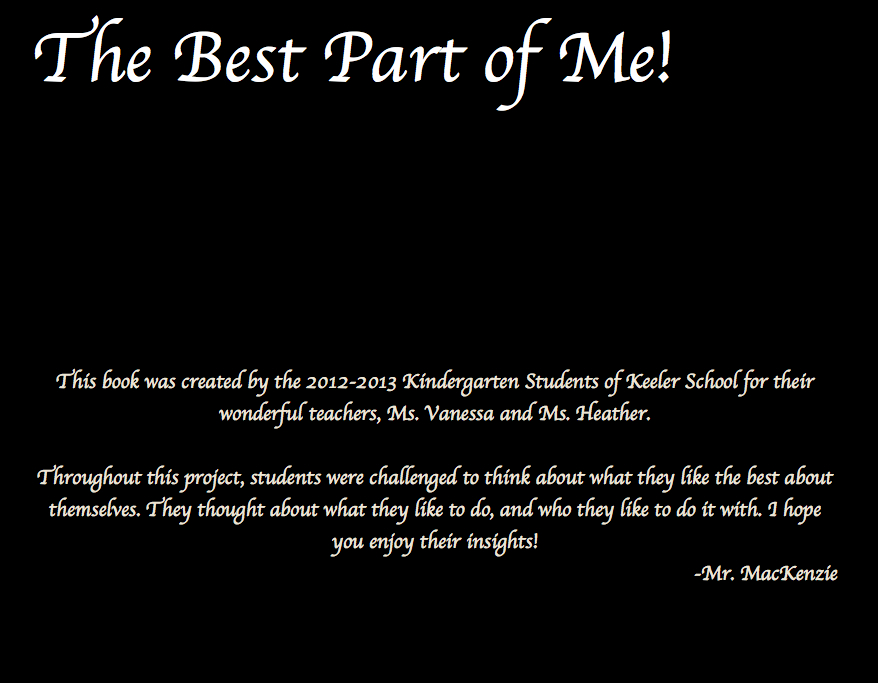
The Best Part of Me!
The Kindergartens and I built a book in the Learning Commons. For the teachers, it really tested our ability to question and to inspire those rich, wonderful utterances from students.
We asked ourselves:
We went for exploring emotions, ideas, feelings, experiences, and for giving meaning to students' daily lives/routines. We read the book "The Best Part of Me" by Wendy Ewald, then turned around and made our own!
It took a while, but we were able to abide by the Reggio Emilia belief that "The child is worthy of being listend to." We honoured how important it is to "listen, observe, interact, and learn from the child(ren)". And really, it was the kids that wrote the book and the teachers who worked on their questioning skills...
Below are some of the pictures from the book. It is absolutely beautiful (for us) because of how the students' voices reflect their personalities and their uniqueness, and how succinctly they touched on the important things in life.
Of course I can't put student names on here, and I've had to blur out faces... But I am working on getting the paperwork done so it can be celebrated! We have published a hard-copy version of it through iPhoto for our Learning Commons... If you're interested, swing by and we'd be happy to show it off!
Here is a link to a small bit of the book.


We asked ourselves:
- How do we generate conversation? How can we forgo "leading" questions?
- How can students express emotions and put meaning to experiences, without an extensive vocabulary? How do we get students to speak in metaphor?
- What questioning encourages students to open up and express their thoughts?
- What is appropriate wait time?
We went for exploring emotions, ideas, feelings, experiences, and for giving meaning to students' daily lives/routines. We read the book "The Best Part of Me" by Wendy Ewald, then turned around and made our own!
It took a while, but we were able to abide by the Reggio Emilia belief that "The child is worthy of being listend to." We honoured how important it is to "listen, observe, interact, and learn from the child(ren)". And really, it was the kids that wrote the book and the teachers who worked on their questioning skills...
Below are some of the pictures from the book. It is absolutely beautiful (for us) because of how the students' voices reflect their personalities and their uniqueness, and how succinctly they touched on the important things in life.
Of course I can't put student names on here, and I've had to blur out faces... But I am working on getting the paperwork done so it can be celebrated! We have published a hard-copy version of it through iPhoto for our Learning Commons... If you're interested, swing by and we'd be happy to show it off!
Here is a link to a small bit of the book.




Sunday, 19 May 2013
The Learning Commons: In Times of Budget Cuts
Times are tough in Alberta! With major provincial cuts to the funding of education, our district has had to make some drastic changes for the next school year. In the end, the changes will make a difference in the classroom, one way or another.
With what looks like a bleak year ahead, one has to wonder if their position is valued enough to remain in place. In times of cuts schools need to look at staffing and prioritize what is crucial and not-so crucial. For schools beginning the journey of transitioning their school library to a learning commons, there will be some tough decisions to be made.
- Will they commit to continuing on this journey?
- Can they afford to put a teacher full time (or in any capacity) in the learning commons?
- How will they possibly put money into the space when that money is being cut?
In my building, we decided to go the learning commons route 3 years ago. In that time, we have learned a lot. For me, the biggest thing to come from it is the fact that when teachers collaborate on projects they are able to share ideas, challenge each other, help each other and generally reflect more often and more easily. When teachers work by themselves, within the 4 walls of their classroom they are confined to their own space and sharing and collaborating becomes much more challenging - It's so easy for teachers to just keep doing what they've always done and are comfortable with and not move their own practice forward.
The learning commons is place that knocks down one of the walls of the classroom, or extends the classroom to have an extra wall, or corner. When we first started the transition we used the analogy that the learning commons would be the 'fifth corner of the classroom'.
In times of cuts, having extra support for teachers will be crucial! With the axing of AISI (Alberta Initiative for School Improvement) this year, schools will not have the expertise and support that AISI provides. It makes me wonder how much pressure the rest of our area and system specialists will be under next year and how easy, or hard, it will be for schools to reach out for extra support. It makes sense to me that if all these supports are cut, then administrators need to make sure there is sufficient support within their own school. The learning commons can provide that support. Having the right person in the learning commons will enable support for both teachers and students which will, in turn, help move the learning forward.
The big question for a lot of administrators would be whether or not the learning commons would actually work without a full time teacher working in the space. I would love to hear of a learning commons space that has a learning commons working well without having a dedicated teacher in the space. In my experience, to maximise the learning that happens, not only in the learning commons but in the entire school, having a teacher that works in a coaching kind of roll builds capacity amongst staff and students alike.
Will our school continue on our mission of developing and focusing on this space? I'm sure we will in some kind of way. Will it be a full time position? I hope so! At one point. I have worked in our learning commons 0.5 of the time (during the last school year) and it was very hard to focus on really utilizing and pushing that space. It may work better now that our staff have a better understanding of what learning looks like in the learning commons.
Time will tell, I guess. Let's see what happens in the learning commons during these tough times and then reflect back. I hope for everyone's sake it works out well and we can make the most of what we have.
The following ideas are my beliefs of what some of the important rolls of the learning commons teacher(s). There are definitely more but these ones will be affected in these tough times: The learning commons teacher...
- works in a learning coach role who is there to support both teachers and students.
- works with teachers to design worthwhile and authentic tasks?
- supports teachers in finding engaging resources that encourage 21st century thinking.
- helps manage and maintain the technology in the school. This proves to be a big time commitment and without someone that can focus on it, the technology could continually prove to be nothing but a problem in the building.
- helps create an environment that provides students with the resources, time, and space they need to follow their passions?
- allows teachers to be able to personalize learning for their students in ways that may not be possible in the classroom.
- helps enhance the community of the school. Being someone that sees what is happening in each and every classroom, the LC teacher is able to mesh projects together and make connections to help make experiences and learning more authentic and exciting.
What do you think about the learning commons teacher? Is is worthwhile position to create/maintain in times of cuts?
Please comment if you can relate to this post.
Subscribe to:
Posts (Atom)